Structural Drying & Dehumidification in Wilmington, NC
Structural drying in Wilmington, NC addresses the moisture that remains in building materials after standing water has been extracted. Surfaces can feel dry to the touch while drywall, wood framing, subfloors, and ceiling cavities remain wet inside. Our team establishes moisture conditions, identifies affected materials, sets drying goals, and uses air movers and commercial dehumidifiers to draw moisture out of saturated assemblies for Wilmington properties.
When Structural Drying Is Needed in Wilmington, NC
Extraction removes the bulk liquid water, but it does not remove the moisture that has absorbed into building materials. That remaining moisture is what structural drying addresses. Drywall wicks water inward, wood framing absorbs it, subflooring saturates beneath flooring, and insulation inside wall and ceiling cavities holds moisture against the structures around it. These materials can feel dry on the surface while remaining wet inside, which is why moisture meters—not touch—are used to verify conditions.
High indoor humidity is a related concern. As wet materials evaporate moisture into the air, indoor humidity rises. Without dehumidification removing that airborne moisture, it can reabsorb into dry materials elsewhere in the structure, spreading the moisture problem rather than resolving it. Wilmington's humid coastal climate can make controlled drying and indoor humidity management especially relevant after a water loss, since ambient humidity already tends to be elevated.
Structural drying is relevant after virtually any water loss that saturated materials—a plumbing leak, a flood, storm intrusion, an appliance failure, or a roof leak. The common thread is that moisture has entered building assemblies and needs to be drawn back out through controlled air movement and dehumidification, with progress tracked by moisture measurement until target levels are reached.
Remaining Moisture After Extraction
Materials that absorbed water during the loss hold moisture inside after standing water is removed, requiring drying to draw it back out of the assemblies.
Saturated Drywall & Framing
Drywall wicks water inward and wood framing absorbs it, leaving both wet inside even after the surface feels dry to the touch.
Wet Subfloors & Floor Systems
Subflooring beneath flooring saturates during a loss and can remain wet long after the floor surface dries, since flooring traps moisture beneath it.
High Indoor Humidity
Evaporation from wet materials raises indoor humidity, which can reabsorb into dry materials elsewhere if dehumidification does not remove it from the air.
Our Structural Drying Process in Wilmington, NC
Structural drying follows a sequence that establishes moisture conditions, identifies affected materials, sets drying goals, places air movers and dehumidifiers, monitors material moisture, and adjusts the equipment strategy until final moisture evaluation confirms target levels.
Establish Moisture Conditions
We measure moisture content in affected materials and establish dry baseline readings for the same material types, so drying progress can be tracked against known targets.
Identify Affected Materials
Moisture meters and infrared imaging identify which materials hold moisture and where, mapping the full drying footprint inside walls, floors, and ceilings.
Set Drying Goals
Based on the moisture map and material types, we set target moisture levels for each affected assembly, giving the drying process a measurable endpoint.
Place Air Movers & Dehumidifiers
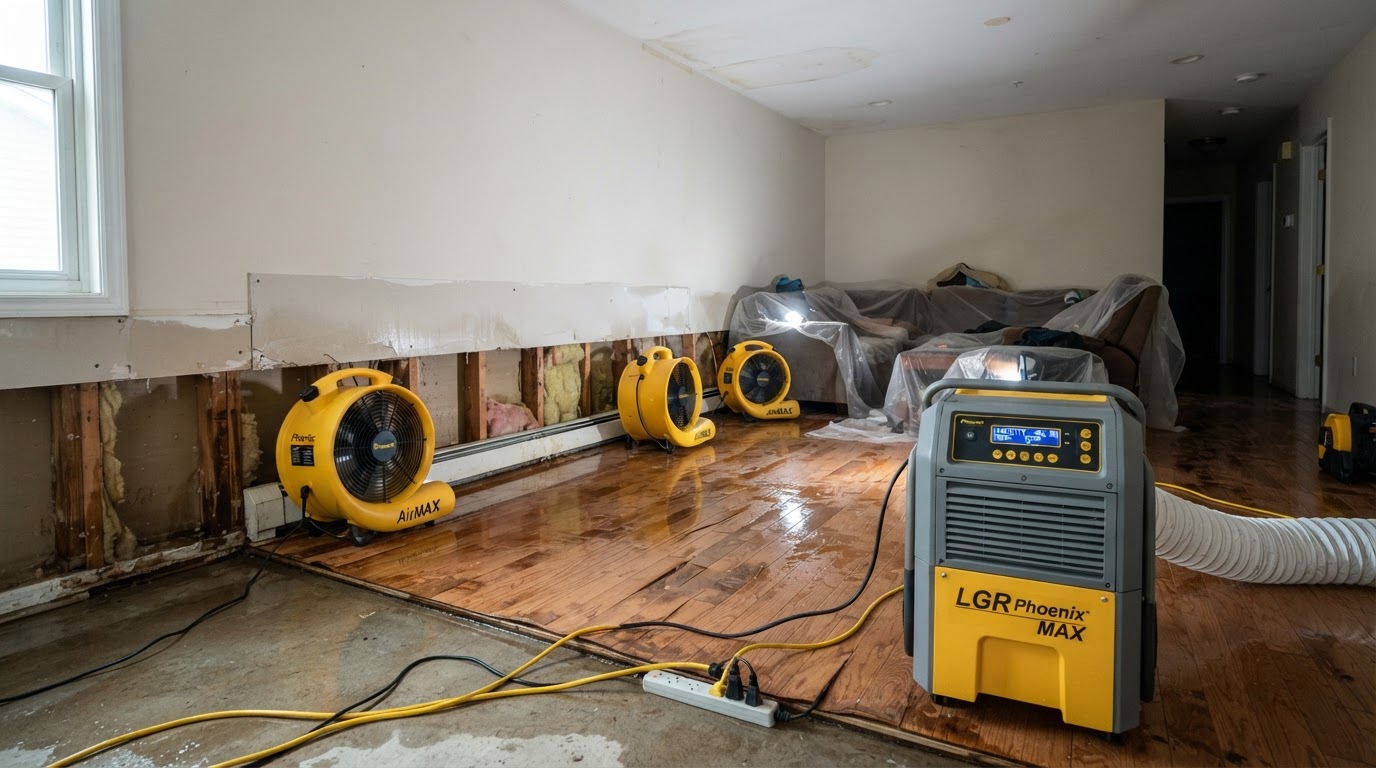
Air movers are positioned to drive evaporation from wet materials, and commercial dehumidifiers capture the moisture released into the air so it does not reabsorb.
Monitor Material Moisture
Daily moisture readings track how each material is drying against its target, confirming progress inside assemblies rather than relying on surface appearance.
Adjust Equipment & Final Evaluation
Equipment is repositioned as materials dry at different rates, and a final moisture evaluation confirms all affected assemblies have reached target levels.
Why Professional Dehumidification Matters After a Leak in Wilmington
Dehumidification is what separates structural drying from simply blowing air across wet surfaces. Air movers accelerate evaporation, but that moisture has to go somewhere—without dehumidification removing it from the air, it reabsorbs into dry materials and the structure never truly dries. Commercial dehumidifiers pull moisture out of the air and lower indoor humidity, creating the conditions that allow wet materials to release their moisture and stay dry. This is why air movement and dehumidification work together rather than independently.
The materials that benefit most from controlled drying are the ones that absorb water deeply: drywall, wood framing, subflooring, and insulation inside cavities. These materials hold moisture against the structures around them, and surface drying does not reach the moisture inside. Moisture meters track conditions inside these materials, measuring actual drying progress rather than guessing based on how the surface feels. Not every wet material can always be saved—some may require removal—but for those that can be dried, controlled dehumidification is what makes it possible.
Wilmington's humid coastal climate makes dehumidification especially relevant. When ambient humidity is already elevated, natural evaporation is slower and the risk of moisture reabsorbing into dry materials is higher. Controlled dehumidification overcomes that by actively removing moisture from the air. For related services, see our emergency water extraction, flood damage cleanup, and burst pipe water damage cleanup pages. Where moisture is hidden in ceilings and walls, see hidden water damage cleanup. For specific drying scenarios, see our crawl space drying and hardwood and subfloor drying pages.
Structural Drying & Dehumidification FAQs for Wilmington Property Owners
Need Structural Drying Near Wilmington?
If materials remain wet after a water loss, call to check current service availability. From moisture mapping and drying goals to air movers and commercial dehumidifiers, our Wilmington team can help dry the structure properly.